Chalked hands grip a barbell overhead against a deep blue sky

The science behind Vita

Every number has a reason.

Your training should not depend on guesswork. Vita combines published research with established coaching practice to build programs you can understand, question and trust. Here is the thinking behind our training recommendations.

The studies appeared in

Am J Sports Med Eur J Sport Sci Int J Sports Med J Orthop Sports Phys Ther J Sports Sci Med Sci Sports Exerc PLoS One Sports Med Sports Med Open

The method in four numbers

Written down, and open to checking.

Every rule on this page is written into the engine that builds your plan, so it is applied the same way each time. Where a rule rests on a study, the study is linked.

18

Published studies informing the training rules

13 are reviews or meta-analyses.

23

Checks on a program

Volume, progression, rest, rep ranges and structure.

8

Running guardrails

They flag a plan that builds too quickly.

5

Strength goal tracks

Build muscle, get stronger, train while losing weight, health and general fitness.

Each number, its rule, its study

What the studies found, and what Vita does with it.

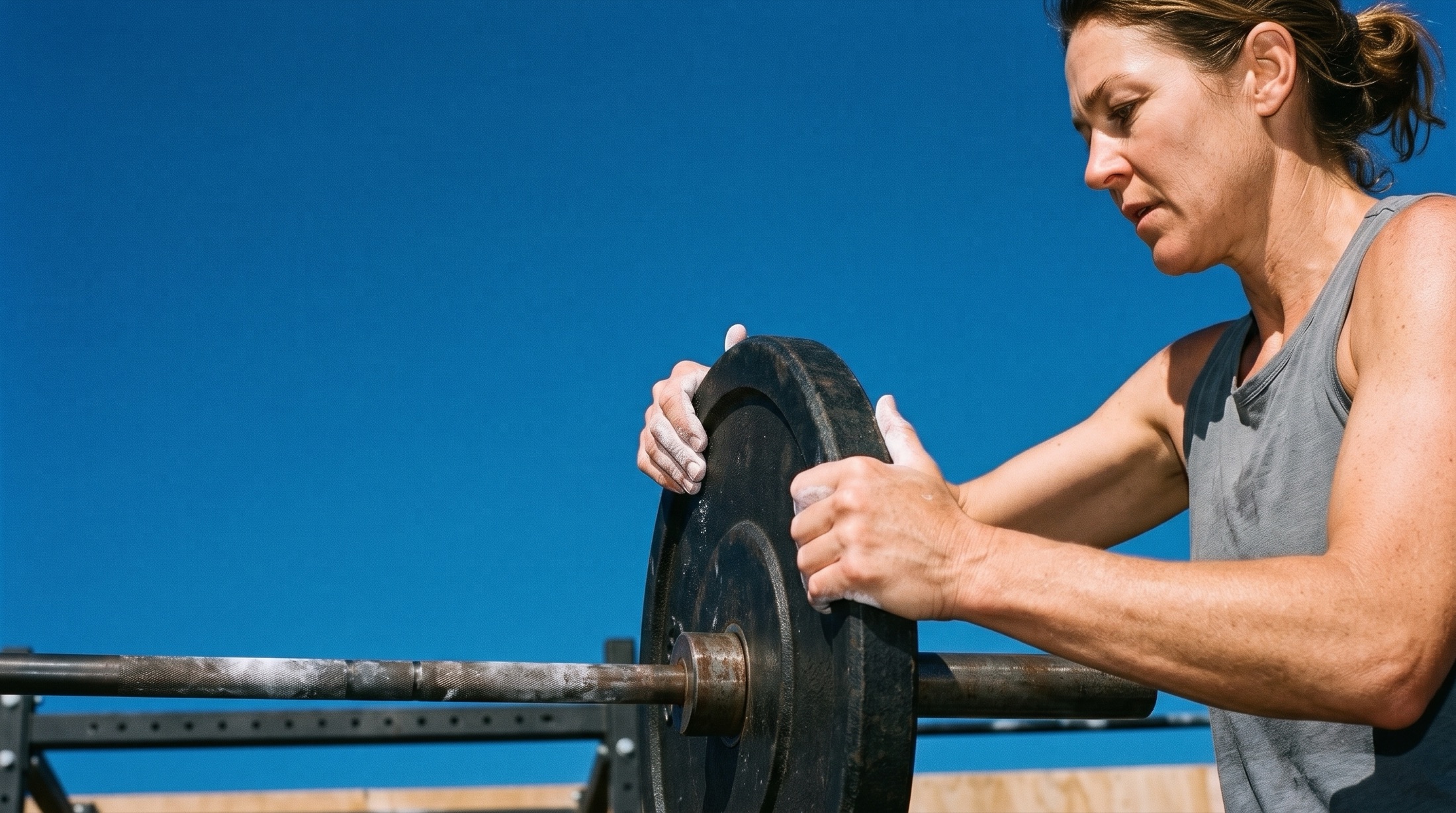
A woman with chalked hands slides a weight plate onto a barbell under a deep blue sky

Strength

0 to 2

reps left in most sets

Sets that stop one or two reps early grew muscle just as well in a direct comparison, at a lower recovery cost.

Refalo MC et al. J Sports Sci 2024

Strength

2 to 3

sets a week still build strength

Gains keep rising with weekly sets, each added set giving a little less. Vita scales your week to the time you have.

Pelland JC et al. Sports Med 2026

Strength

2x

each muscle a week, as a default

How often you train a muscle matters little for size when the weekly work is equal, and more for strength. Twice a week is a practical way to spread the work, not a proven best.

Schoenfeld BJ et al. J Sports Sci 2019

A runner mid-stride on a red track against a deep blue sky

Strength and running

Lift first

when both land on one day

Across 43 studies, adding endurance work did not reduce muscle size or maximal strength. Order matters a little for leg strength.

Eddens L et al. Sports Med 2018

Progress takes more than a good plan.

A runner rests with hands on knees after a hard rep on a track while two others run past, under a deep blue sky

Coaching

Log, then review

a goal you look at again

In 122 programmes, tracking worked best when it came with a goal and feedback. Vita pairs every log with a weekly target you chose.

Michie S et al. Health Psychology 2009

Coaching

Your goal

specific, and chosen by you

Specific, challenging goals that a person accepts lead to more than "do your best". So Vita drafts a goal in your words, and it starts only when you confirm it.

Locke EA, Latham GP. Curr Dir Psychol Sci 2006

Inside the engine

The same rules, every day, applied to you.

A few of the rules Vita applies each time it builds your plan or suggests a change, in plain words.

Strength
  • The weight goes up once you hit the top of your rep range two sessions in a row.
  • Steps of 4 to 5 percent, rounded to plates you can actually load.
  • An easier week is suggested when your training calls for it. It is never applied for you.
Running
  • Hard days never sit back to back.
  • One missed run changes nothing. After two, Vita offers an easier week.
  • A first 5K starts with run and walk: 3 minutes of jogging, building to running without a stop.
Coaching
  • Your recovery is read against your own 14-day baseline, never against other people.
  • A goal has three layers: who you want to be, a weekly target, and an outcome if you want one.
  • Your daily check-in asks how stressed and how motivated you feel, not only how you slept.
Where the evidence ends
  • Some training decisions rest on strong published evidence. Others rely on established coaching practice where direct research is limited. You deserve to know the difference, so both are shown.
  • Coaching practice, with no trial behind it: how much weight to add, how far to step back after a break, and adding reps before weight.
  • How often an easier week comes, and the exact weekly set ranges.

All 18 training studies

Read the papers yourself.

Show all 18 studies
  • StrengthGrgic J et al. The effects of short versus long inter-set rest intervals in resistance training on measures of muscle hypertrophy. Eur J Sport Sci 2017. Systematic reviewPubMed 28641044
  • StrengthSchoenfeld BJ et al. How many times per week should a muscle be trained to maximize muscle hypertrophy? J Sports Sci 2019. Meta-analysis, 25 studiesPubMed 30558493
  • RunningBuist I et al. No effect of a graded training program on the number of running-related injuries in novice runners. Am J Sports Med 2008. Randomised trialPubMed 17940147
  • RunningNielsen RO et al. Excessive progression in weekly running distance and risk of running-related injuries. J Orthop Sports Phys Ther 2014. Cohort studyPubMed 25155475
  • RunningCampos Y et al. Training-intensity distribution on middle- and long-distance runners: a systematic review. Int J Sports Med 2022. Systematic reviewPubMed 34749417
  • RunningMuniz-Pumares D et al. The training intensity distribution of marathon runners across performance levels. Sports Med 2025. Observational studyPubMed 39616560
  • RunningBosquet L et al. Effects of tapering on performance: a meta-analysis. Med Sci Sports Exerc 2007. Meta-analysis, 27 studiesDOI
  • RunningWang Z et al. Effects of tapering on performance in endurance athletes. PLoS One 2023. Meta-analysisPubMed 37163550
  • Strength and runningSchumann M et al. Compatibility of concurrent aerobic and strength training for skeletal muscle size and function. Sports Med 2022. Meta-analysis, 43 studiesPubMed 34757594
  • Strength and runningEddens L et al. The role of intra-session exercise sequence in the interference effect. Sports Med 2018. Meta-analysisPubMed 28917030
  • Strength and runningHuiberts RO et al. Concurrent strength and endurance training: the impact of sex and training status. Sports Med 2024. Meta-analysis, 59 studiesPubMed 37847373
  • Strength and runningLundberg TR et al. The effects of concurrent aerobic and strength training on muscle fiber hypertrophy. Sports Med 2022. Meta-analysisPubMed 35476184

How a day is planned

The plan proposes. You decide.

Vita asks, listens and reflects back before suggesting anything. Nothing in your plan changes without your yes.

  1. Read your night and your week
  2. Check the day against the rules
  3. Draft today
  4. You say yes

Fair things to ask.

Is Coach Vita a medical product?
No. Coach Vita is a training and wellness app. It is not a medical device and does not diagnose, treat or prevent any condition.

What if the research and my body disagree?
Research describes groups of people. Your plan is built around you, and it changes when you ask. You always have the last word.
Why show the rules that are not proven?
Because a method you can trust says where its evidence stops. Several of Vita's rules are coaching practice, and they are listed on this page as exactly that.

See the reasons in your own plan.

Join the beta

Coach Vita is a training and wellness app. It is not a medical device and does not diagnose, treat or prevent any condition.